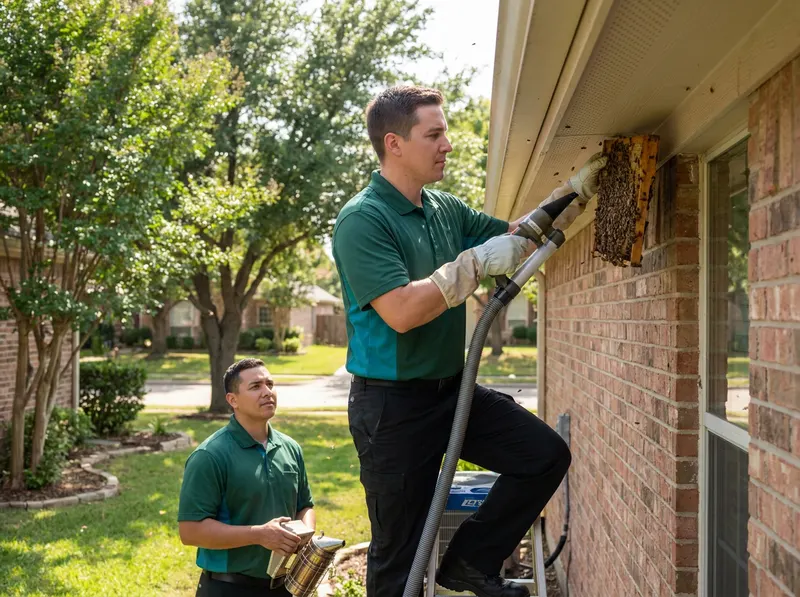
Bee removal in Keller, TX by InsectOut Pest Control. Live honey bee relocation, wasp and nest handling, priced after an on-site inspection. Call (817) 309-
InsectOut Pest Control provides Bee Removal in Keller, TX.
A honey bee colony and a wasp nest look alike from ten feet away but call for opposite handling, and getting the identification right is the first thing InsectOut Pest Control confirms on site. Honey bees cluster in the thousands, build wax comb, and are protected pollinators, the EPA's pollinator protection guidance and federal pollinator programs both recognize their role, which is why a reachable honey bee colony in Keller is relocated live rather than sprayed.
Wasps, yellowjackets, and hornets are not pollinators in the same sense, defend their nests aggressively, and are removed directly. Misidentifying the two is the most common reason a DIY spray fails: store insecticides scatter a honey bee swarm without reaching the comb, and the colony rebuilds within days.
Step 1 is the phone or texted-photo assessment, which narrows the species before anyone is dispatched across Keller, from Hidden Lakes and Marshall Ridge on the newer west side to the older tree canopy around Keller Oaks and Woodland Estates. Step 2 is the on-site inspection, where the entry point, the direction of comb, and the depth of the void are located; honey bees entering a brick weep hole in Saddlebrook Estates or Bloomfield Estates often run the comb up inside the wall cavity, not just behind the surface.
Step 3 is extraction or treatment. Step 4 is sealing or recommending a seal of the opening, because an unsealed cavity that still smells of old comb draws a new swarm the following spring. Step 5 is advising on comb and honey removal when a wall has been opened, since abandoned honey can seep, stain drywall, and attract ants and rodents later, a crucial detail many homeowners miss.
Timing in Keller follows a season.
Swarms, a mobile cluster of bees that has left a hive and may hang on a fence post or Bradford pear branch for a day or two before choosing a permanent cavity, peak in spring, roughly April through June, and are typically the easiest and least invasive to relocate because no comb has been built yet. A colony discovered in summer or fall in a soffit near The Highlands or Oakmont Hills has usually built established comb and is a larger job. Honey bee activity along the Big Bear Creek Greenbelt and the wooded edges of Bear Creek Park is normal foraging and does not indicate a colony in a nearby house; the Texas Apiary Inspection Service at Texas A&M tracks hive health across Tarrant County and is the state authority on managed bee colonies.
If the colony is in a reachable branch, swarm cluster, or shallow structure, live relocation is the fit, it protects the pollinator and avoids opening a wall.
If bees are deep inside a two-story soffit in Overton Ridge or inside a chimney flue, the trade-off shifts: reaching live comb may require opening the structure, so some situations are handled as a controlled removal with sealing rather than a clean relocation. Aggressive stinging insects near a CDC-documented sting risk area, a child's playset, an entry door in Harmonson Farms, or an HVAC unit, are treated as a safety priority regardless of species. For families asking about pets and children, product choice and placement follow the label directions required under EPA pesticide registration, and honey bee relocation uses no broadcast spray at all.
The Pollinator Partnership and the USDA NRCS pollinator resources explain why live relocation is preferred, and the USDA Agricultural Research Service documents the pressures on honey bee populations that make relocation the responsible default. Jobsite ladder and fall safety on multi-story removals follows OSHA ladder standards.
Every job gets a firm, written price after an on-site visit.
Tell us about your bee removal job in Keller and we'll send a clear, written quote, usually the same day.
 InsectOut Pest Control